
If you’ve noticed your clients (and prospects) watching more content through apps than cable boxes, you’re not imagining it. Streaming is now the standard. That’s exactly why connected TV (CTV) has become one of the most practical brand-building and lead generation channels available to independent financial advisors.
The good news: You don’t need a massive budget, a production studio, or a full-time marketing team to start. You need a clear strategy, compliant messaging, and a way to connect TV awareness to measurable business outcomes.
Let’s walk through what CTV is, why it matters for independent advisors right now, and how to launch a smart first campaign without wasting dollars.
What Is CTV, and Why Should Advisors Care?
CTV is advertising shown on internet-connected televisions through streaming apps (for example, live TV streaming platforms and on-demand streaming services). Unlike traditional TV, CTV can be targeted to specific audiences and measured more like digital marketing.
For financial advisors, CTV is powerful because it can:
- Build credibility at scale in a premium environment
- Reach households that match your ideal client profile
- Support niche growth goals (retirement income, tax planning, business owner planning, and more)
- Pair awareness with trackable next steps (site visits, guide downloads, appointment requests)
The CTV Shift: What’s Changed (And Why It Helps You)
CTV used to feel like “TV marketing,” which many advisors mentally file under expensive, broad, and hard to measure. However, the modern CTV approach looks different:
#1: Better Targeting Without Losing Brand Safety
CTV targeting can align to geography, household traits, and content context. For financial services, that “context” piece is important to note: You want your brand to show up in environments that reinforce trust.
#2: Measurement That Connects Awareness to Action
CTV is increasingly planned alongside web and search. When your spot runs, you can watch for lift in branded search, landing page visits, and guide downloads. You’re not guessing if it worked. You’re looking for signals that match your goal.
#3: Creative That Doesn’t Require a Big Production Budget
Advisory firms win on clarity, confidence, and consistency. A simple, well-scripted 15- or 30-second spot that speaks to a real client pain point can outperform “flashy” creative that says nothing.
Related: How Financial Advisors Can Use Webinars to Attract and Convert Clients
Where CTV Fits in an Advisor Marketing Strategy
Most independent advisors don’t need CTV as a standalone tactic, but rather as a force multiplier across the channels they already use.
Here’s the simplest way to think about it:
- CTV creates demand (awareness, credibility, recall)
- Search captures demand (prospects look you up, compare options, and take action)
- A strong landing page converts demand (guide download, consultation request, event registration)
That’s also where search engine optimization (SEO) and answer engine optimization (AEO) come in.
When your CTV runs, prospects often do one of two things:
- They search your name
- They search the problem you help solve
If your website content answers those questions clearly (AEO) and ranks for the right terms (SEO), you convert more of the attention you paid for.
A Practical “First Campaign” Framework for Independent Advisors
If you’re starting CTV for the first time, the main goal is to create a clean test environment that generates insights you can scale.
Step #1: Choose One Audience and One Outcome
Pick a single audience segment and a single primary action. For example:
- Pre-retirees within a specific radius of your office
- Business owners looking for exit planning support
- Families searching for retirement income clarity
Then pick one outcome:
- Guide download
- Consultation request
- Webinar registration
Avoid mixing audiences and actions in your first run. Focus on simpler wins.
Step #2: Match the Message to the Moment
CTV is a story, and your best-performing message usually does three things:
- Names a familiar concern
- Offers a clear, specific solution
- Points to a simple next step
For example, a retirement-focused message might lead with uncertainty around income, taxes, or market volatility, then position your process as the path forward.
Step #3: Build a Landing Page That Mirrors the Spot
When someone goes from TV to phone, they expect continuity in both message and branding. Your landing page should:
- Repeat the headline promise from the ad
- Explain who the offer is for
- Provide a short list of outcomes
- Include one strong call to action (CTA)
- Add credibility signals (credentials, process, testimonials if allowed, and compliance-reviewed language)
If you’re targeting SEO and AEO, include a short FAQ on the page that answers the exact questions prospects ask in plain language.
Step #4: Layer Retargeting So You Don’t Pay Twice
Most people won’t convert on the first touch, and that’s completely normal. A strong CTV strategy includes retargeting to keep you visible to visitors who landed on the landing page but didn’t take the next step.
This is how you turn brand exposure into a pipeline for your business over time.
Step #5: Measure What Matters (And Keep It Simple)
For a first campaign, track a small set of signals tied to your outcome:
- Landing page visits
- Guide downloads or form fills
- Consultation requests
- Branded search lift (if you have the tooling)
- Cost per action over time
Then decide what you’ll test next: audience, creative, offer, or landing page. It’s always better to test one component at a time, so you can pinpoint exactly what’s helping or hurting your efforts.
What Good Creative Looks Like on CTV
Advisor creative works best when it’s:
- Clear, not clever
- Calm, not hype-driven
- Specific, not generic
- Client-centered, not product-centered
A simple structure you can reuse:
- Hook: “Worried about turning savings into reliable income?”
- Value: “We help families build a retirement strategy designed for taxes, inflation, and real life.”
- Credibility: “Independent guidance, clear process, and a plan you can understand.”
- CTA: “Download our guide and see the first steps.”
Related: The Financial Professional’s Quick Guide to Educational Content Marketing
Full-Funnel CTV Case Study
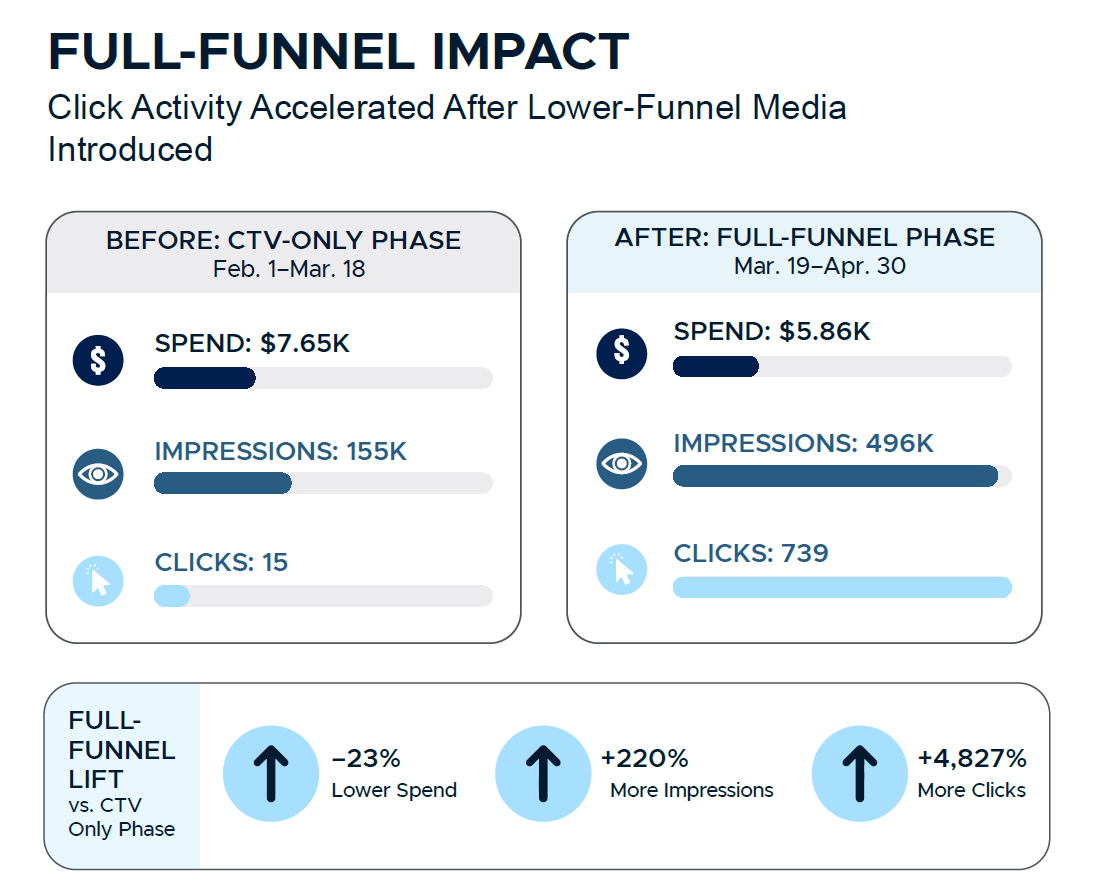
A recent client who committed to a CTV strategy wanted more than brand awareness. They needed a way to build local recognition while generating measurable engagement and website activity. By combining CTV with display advertising and remarketing, the campaign created a full-funnel path from awareness to action.
- Challenge: The advisor wanted to leverage CTV for brand awareness but needed proof that media spend was driving measurable engagement, including website visits, clicks, and conversion activity. CTV alone was viewed as too top-of-funnel for their liking.
- Approach: The campaign launched with targeted CTV ads focused on affluent households in the advisor’s core South Carolina markets. Midway through the campaign, display advertising and remarketing were added to create a full-funnel strategy. Audience targeting included age and household income filters, ZIP-code prioritization, a 30-mile geographic radius around key markets, and pixel-based conversion tracking.
- Outcome: The campaign generated 650,000 impressions, 198,000 video completions, and 754 total clicks. After display and remarketing were introduced, the full-funnel phase produced 739 clicks, representing approximately 98% of all campaign clicks, while delivering 220% more impressions and 4,827% more clicks than the CTV-only phase.
- Why it worked: CTV built awareness and credibility with the right audience, while display and remarketing provided a direct path to engagement and action. The combination of premium video exposure, precise audience targeting, and measurable tracking transformed CTV from a branding channel into a performance-driven marketing strategy.
Note: If you want to see more, click here to receive a PDF of the full case study.
CTV FAQs
Do I need a big budget to start CTV?
No. A smart first campaign is a focused test with one audience and one outcome. The key is aligning the ad, the landing page, and measurement so you learn quickly.
What should my first CTV offer be?
Start with a helpful, low-friction offer that fits your niche, like a guide or webinar. Prospects are more likely to engage with education before committing to a meeting.
How do I know if CTV is working?
Look for increased visits to a dedicated landing page, guide downloads, consultation requests, and lift in branded or topic-related searches during the campaign window.
What is the biggest mistake advisors make with CTV?
Treating it like traditional TV. The win is pairing TV credibility with digital targeting, a clear CTA, and measurement that connects exposure to action.
Ready to Explore CTV? We Help You Launch It the Right Way
CTV can be one of the fastest ways to build local credibility and consistent visibility, especially when it’s connected to a real conversion path. If you want help mapping a compliant, measurable CTV strategy, our experts can walk you through targeting, creative, landing pages, and performance tracking.
Click the button below to show your interest and receive a full case study to see the impacts of a strong CTV strategy.